Managing Roles
This guide covers role assignment, the permission matrix for built-in roles, and the behavioral quirks you should know about when permissions interact across modules. For conceptual background, see Roles & Permissions.
Assigning roles
Section titled “Assigning roles”Admins (or any member with users:manage) can assign roles from Settings > Team. Select a member to view and change their assigned roles.
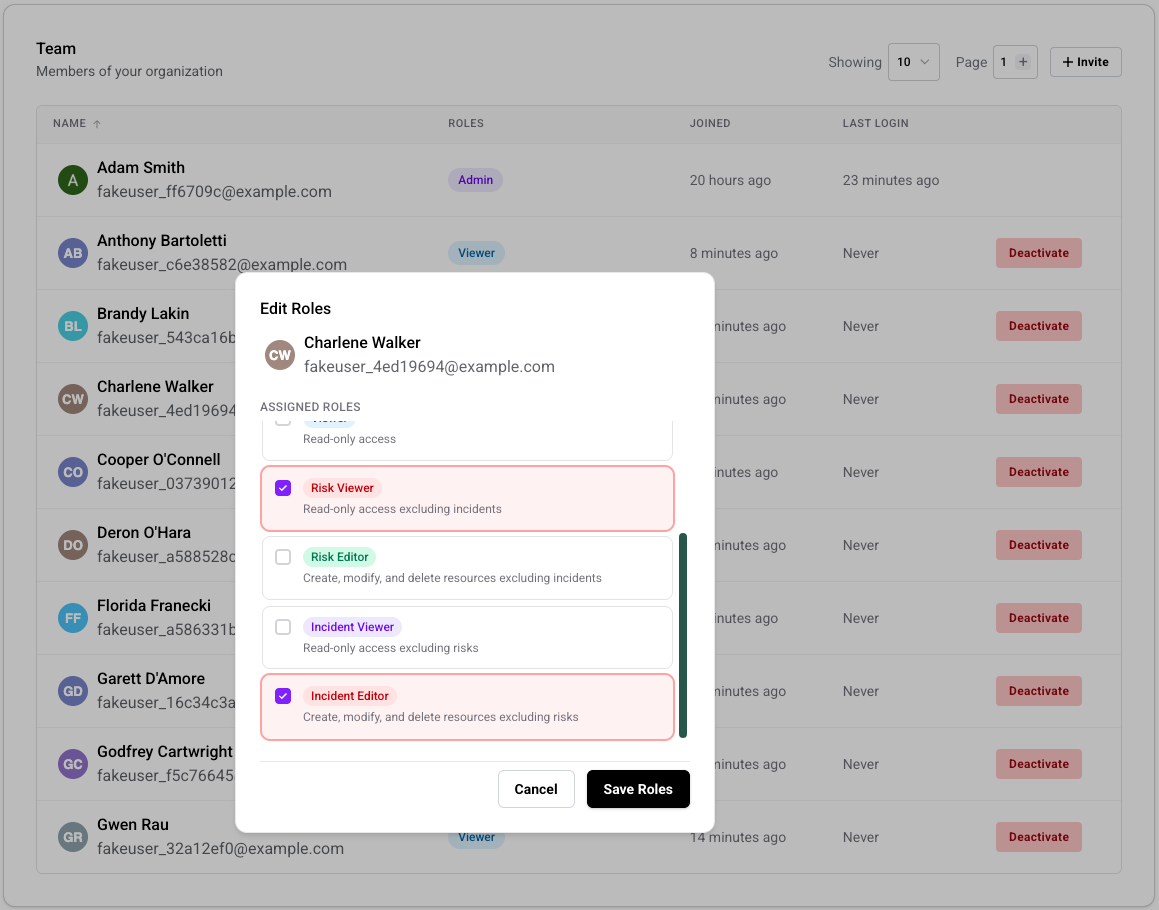
Members can hold multiple roles simultaneously. Permissions are unioned across all assigned roles — see how multiple roles combine.
Restrictions on role assignment
Section titled “Restrictions on role assignment”The platform enforces several rules to prevent privilege escalation:
- Assigning roles at all requires
users:manage, which among the built-in roles only Admin holds. An Editor cannot assign the Admin role — or any other role — because it never reaches the assignment surface. - You can only grant permissions you hold. For anyone who does hold
users:manage, the subset rule still applies: if the combined permissions of the roles you’re assigning exceed your own, the request is rejected. - Only Admins can assign the Admin role. The platform checks that the assigning user holds the Admin role itself — holding every permission is not enough.
- You cannot change your own roles. Role changes must be made by another member with
users:manage. This prevents accidental self-lockout and ensures a second pair of eyes on privilege changes. - The last Admin cannot be removed. See the admin invariant.
Permission matrix
Section titled “Permission matrix”This table shows which permissions each built-in role includes.
| Permission | Admin | Editor | Viewer | Risk Editor | Risk Viewer | Incident Editor | Incident Viewer |
|---|---|---|---|---|---|---|---|
risks:read |
Y | Y | Y | Y | Y | ||
risks:write |
Y | Y | Y | ||||
incidents:read |
Y | Y | Y | Y | Y | ||
incidents:write |
Y | Y | Y | ||||
threats:read |
Y | Y | Y | Y | Y | Y | Y |
threats:write |
Y | Y | Y | Y | |||
threats:manage |
Y | Y | Y | Y | |||
documents:read |
Y | Y | Y | Y | Y | Y | Y |
documents:write |
Y | Y | Y | Y | |||
documents:manage |
Y | Y | Y | Y | |||
integrations:read |
Y | Y | Y | Y | Y | Y | Y |
integrations:manage |
Y | ||||||
tags:read |
Y | Y | Y | Y | Y | Y | Y |
tags:write |
Y | Y | Y | Y | |||
organization:manage |
Y | ||||||
users:read |
Y | Y | Y | Y | Y | Y | Y |
users:manage |
Y |
Module-specific behavior
Section titled “Module-specific behavior”Permissions don’t always interact the way you’d expect. The sections below document the important edge cases.
Tags require dual permissions
Section titled “Tags require dual permissions”Tag management (creating, editing, deleting the organization’s shared tags) is gated by tags:write. Your own personal portfolio tags are always available to you and need no tag permission. Deleting an organization-wide tag additionally requires risks:write and incidents:write, because the deletion also updates the risks and incidents the tag is applied to. And assigning a tag to a risk requires both risks:write and tags:read. Having one without the other is not enough:
tags:writewithoutrisks:write— you can create tags in Settings but cannot apply them to risksrisks:writewithouttags:read— you can edit risks but the tag picker is not available
Threats: write vs. manage
Section titled “Threats: write vs. manage”The Threats module uses a proposal workflow with two distinct permission levels:
| Action | Required permission |
|---|---|
| View the threat profile | threats:read |
| Create or edit a threat proposal | threats:write |
| Approve a threat proposal | threats:manage + risks:write |
| Deny a threat proposal | threats:manage |
Approving a threat proposal requires risks:write in addition to threats:manage. Denying a proposal requires only threats:manage.
Admin, Editor, and Risk Editor hold both threats:manage and risks:write, so they can approve proposals. Incident Editor holds threats:manage but not risks:write — it can deny proposals but not approve them.
Documents: write vs. manage
Section titled “Documents: write vs. manage”Documents follow a similar proposal pattern:
| Action | Required permission |
|---|---|
| View and download documents | documents:read |
| Edit document content | documents:write |
| Approve or deny document change proposals | documents:manage |
| Export a governance report | All 7 read permissions |
Governance report exports require all read permissions because the report aggregates data across risks, incidents, threats, and compliance. A domain-scoped viewer (e.g., Risk Viewer) cannot generate these exports.
Comments inherit parent permissions
Section titled “Comments inherit parent permissions”Comments do not have their own permission. Instead, they inherit from the parent resource:
- Commenting on a risk requires
risks:write - Commenting on an incident requires
incidents:write - Editing or deleting another member’s comment additionally requires
organization:manage
Members with read-only access to a module can see existing comments. The composer still accepts typing, but submitting is rejected with a permission message.
Attachments inherit parent permissions
Section titled “Attachments inherit parent permissions”Attachments follow the same rule as comments: adding or removing a file on a risk (or on a comment on it) requires risks:write, and on an incident requires incidents:write. Members with read-only access to a module can view and download its attachments but cannot add or remove them.
Compliance uses document permissions
Section titled “Compliance uses document permissions”There is no separate compliance permission. The Compliance section is gated by documents:read, and editing document content requires documents:write. Every built-in role includes documents:read, so all members — including Risk Viewer and Incident Viewer — can see Compliance, whether or not they can see the risk register.
Integrations: no write tier
Section titled “Integrations: no write tier”Integrations have only two permission levels: integrations:read (view configuration) and integrations:manage (connect, configure, remove). There is no intermediate write tier. Editors can view integration settings but cannot modify them.
Organization settings are admin-only
Section titled “Organization settings are admin-only”Editing the organization name, description, or domain settings requires organization:manage, which only Admins hold among the built-in roles. The Company settings page is visible to all members, but form fields are disabled for non-admins.
Export and import
Section titled “Export and import”| Action | Required permission |
|---|---|
| Export risks to CSV | risks:read |
| Import risks from CSV | risks:write |
| Import risks from a document with AI | risks:write + tags:write |
| Export incidents to CSV | incidents:read |
| Import incidents from CSV | incidents:write |
| Import incidents from a document with AI | incidents:write + tags:write |
Read permissions are sufficient for export; write permissions are required for import. AI document import additionally requires tags:write because it can tag the whole imported batch in one step — the built-in roles that hold risks:write or incidents:write also hold tags:write, so this only affects custom roles.
What the UI shows for limited permissions
Section titled “What the UI shows for limited permissions”The platform degrades gracefully for members with limited access:
- Locked sidebar links — Modules you cannot access show a lock icon and a tooltip (“You don’t have permission to view…”). The links are visible but not clickable.
- Access denied pages — Navigating directly to a module you lack read permission for shows a lock icon with an access denied message.
- Read-only banners — When you can view a module but not edit it, a dismissible banner appears: “You have read-only access to [module]. Contact your admin to request edit access.”
- Greyed-out controls — Write actions (comment composers, edit buttons, form fields) appear greyed out and disabled rather than hidden, so you can see what actions exist without being able to perform them.
- Home page eye icon — If you have no write permissions in any module, the header shows an eye icon indicating read-only mode.
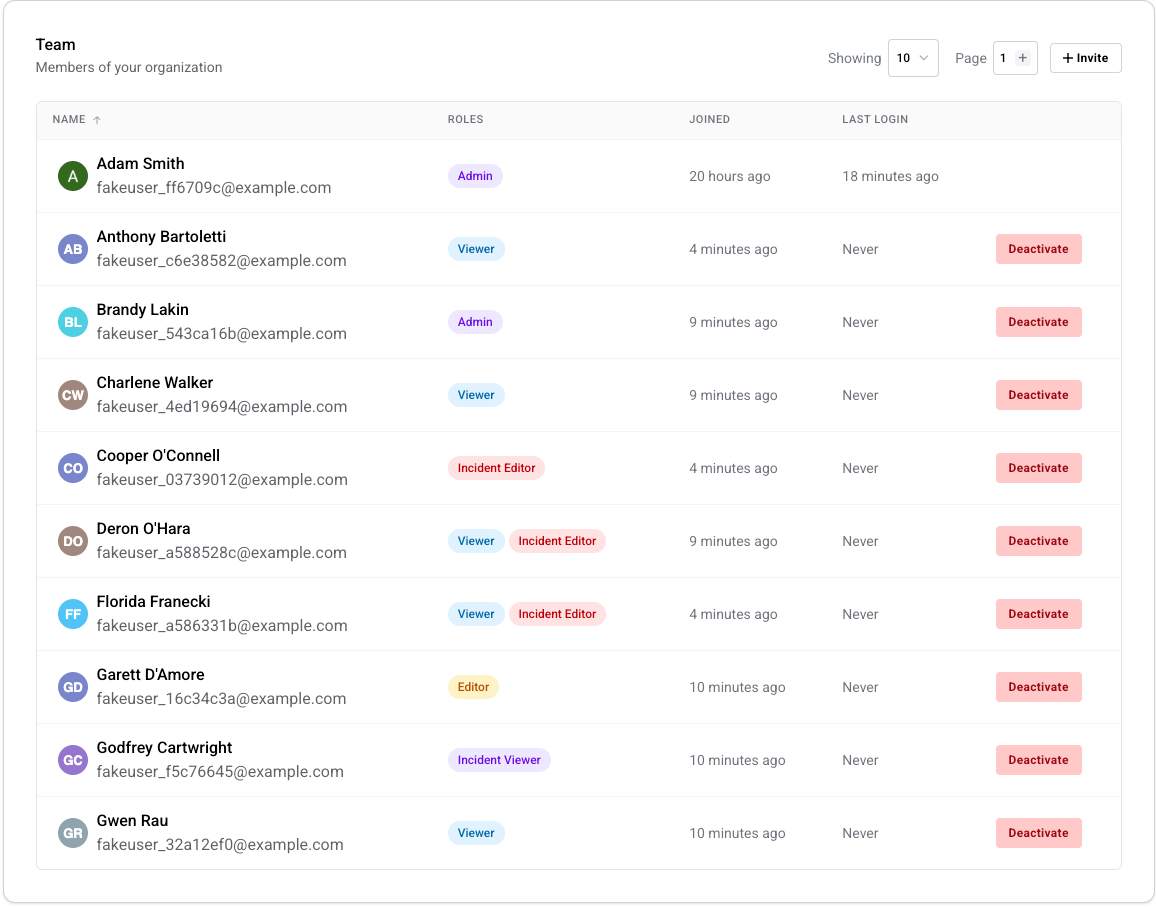
The Team page itself demonstrates this pattern. An Admin sees the full member list alongside Deactivate buttons and the + Invite action:
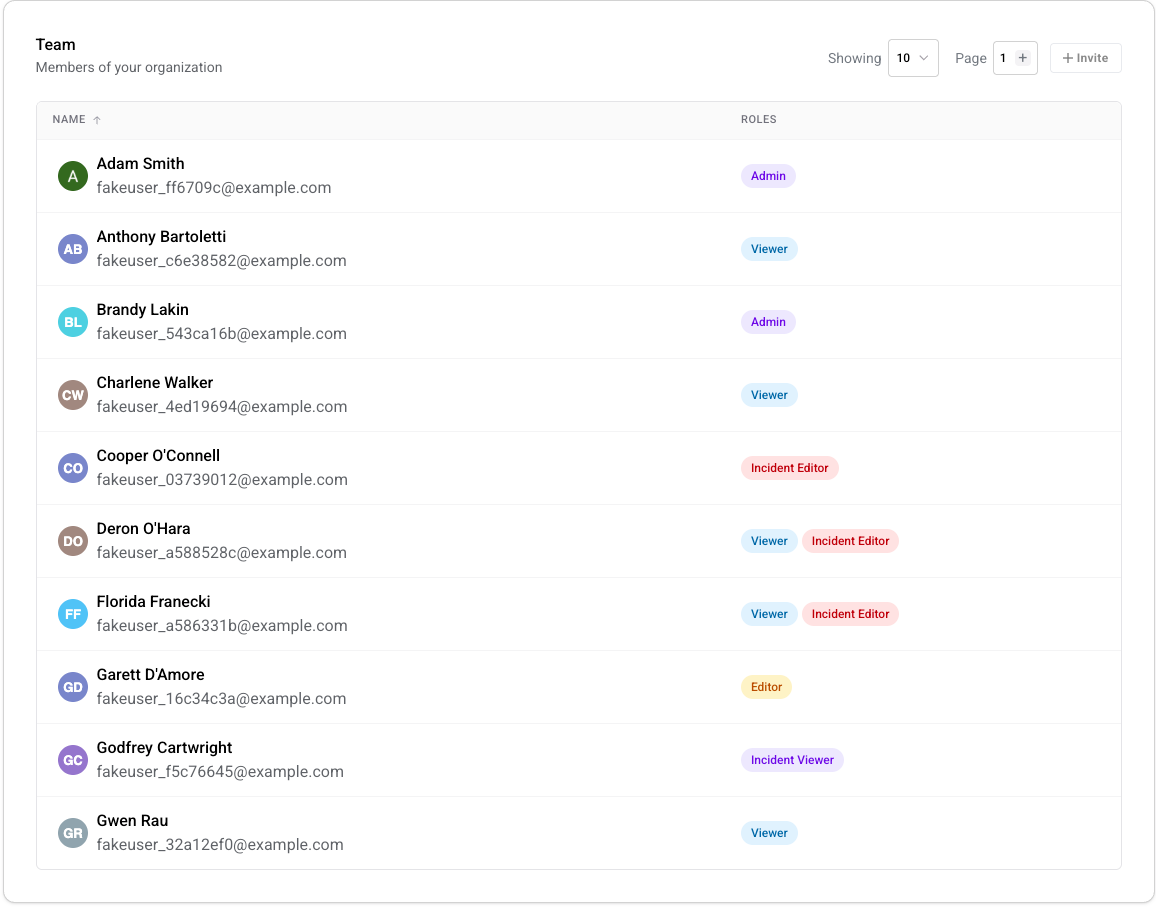
A member without users:manage sees the roster with the Name and Roles columns only. The per-member Edit roles and Deactivate controls are not shown, and the Invite button is greyed out with a tooltip explaining the missing permission:
Inviting new members
Section titled “Inviting new members”When inviting a new member, the invite includes the roles they will be assigned upon acceptance. The same assignment restrictions apply — you cannot invite someone with permissions that exceed your own.
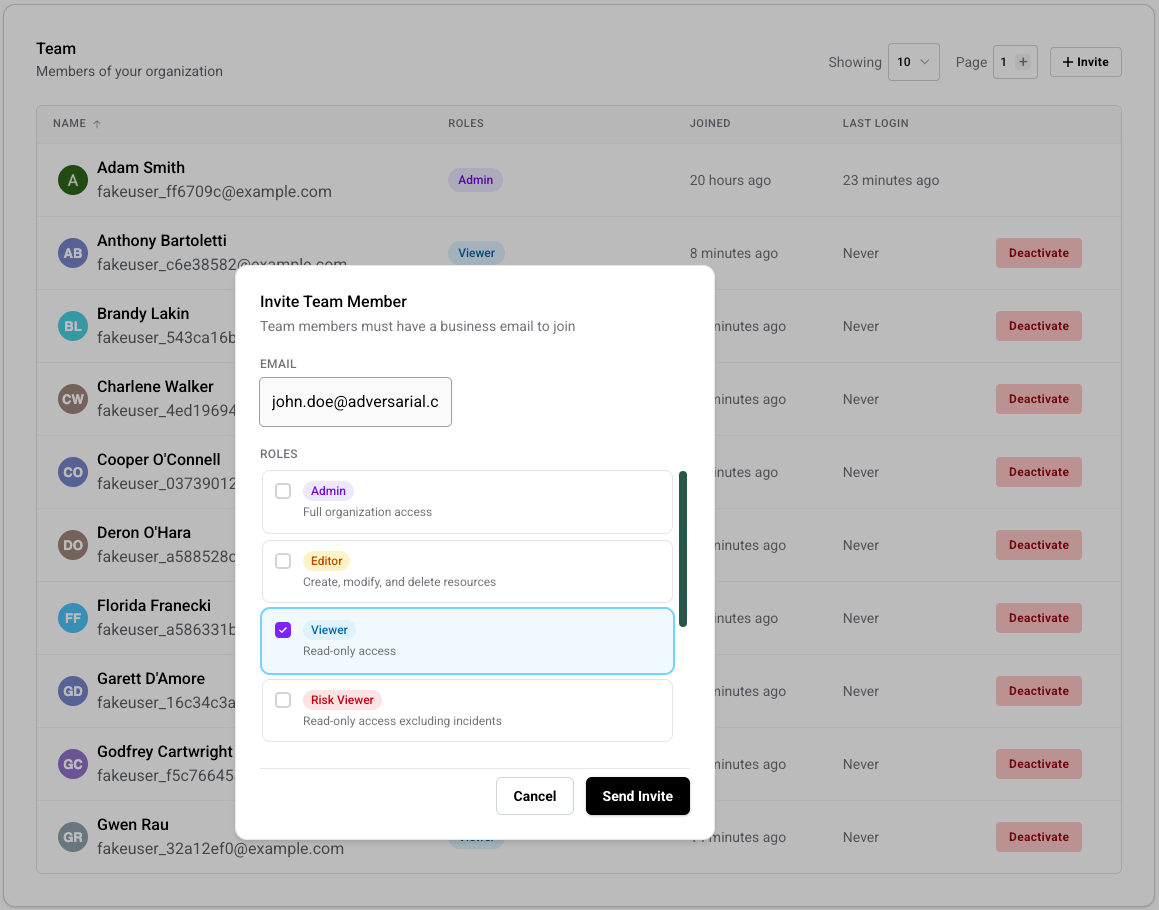
Every invite must include at least one role — an invite with no roles selected is rejected. The invite records the role selection at the time it’s sent; if role definitions change between sending and acceptance, the member receives the updated permissions for those roles.
Deactivating members
Section titled “Deactivating members”Deactivating a member is a soft removal — their account remains in the system but they lose all access to the organization. Their role assignments are kept, so reactivating a member restores their account with the same roles they had before.
The last-admin constraint applies here too: you cannot deactivate the organization’s last remaining Admin.
Leaving an organization
Section titled “Leaving an organization”Any member can leave an organization themselves from Settings > Company by selecting Leave Organization and confirming. Leaving removes your access to the organization’s data and settings, and an administrator has to invite you again for you to rejoin. If you belong to only one organization, leaving is allowed: you are signed in to onboarding, where you can create a new organization.
The confirmation tells you what leaving will do:
- API keys you own are revoked. The dialog shows how many active service accounts you created. Anything still using them needs a new key from another member.
- The last administrator can’t leave. Assign the Admin role to another member first, as with deactivating the last Admin.
- If you are the only member, leaving closes the organization for good: pending invitations are deleted, its API keys are revoked, and no one can rejoin.
Service accounts can’t leave an organization.